
On the border dispute, officials on both sides say the protracted boundary talks made progress, while both sides made attempts to avert tensions along the 3,488-kilometre-long Line of Actual Control, which remains undefined.

It is a dark legacy bequeathed by Nehru to India. In its DNA lies the subconscious fount of India's schizophrenic geopolitics that forsook in one sweep all its historically-entrenched strategic interests in Tibet in favour of China, says R N Ravi, on the 60th anniversary of the Panchsheel Agreement.

Lu said China will take 'further action' to safeguard its sovereignty.

'Magnanimity and appeasement have no place in the world of realpolitik as India has learned the hard way,' notes Vivek Gumaste in the first of a two-part column.
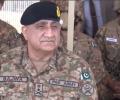
'The picture only looks worse from where Bajwa sits.' 'He sees a domineering India to the east, an unravelling Afghanistan and a complex Iran to the west, an overbearing China on the north and a US which is no longer an ally,' observes Shekhar Gupta.

Prime Minister Narendra Modi and Chinese President Xi Jinping on Thursday began summit-level talks.

'China, much more than Pakistan, is a credible potential adversary with the ability to hurt our interests.' 'It must figure higher in our national security concerns,' says Vice Admiral Premvir Das (retd).

India must break out of this strategic triangulation between China and Pakistan. We need to settle our issues with one of the two, notes Shekhar Gupta.
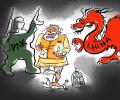
'China need not worry about a truly 'resurgent India'.' 'It's not going to happen.'

'The Chinese made their point repeatedly after August 5. They backed Pakistan more overtly than in the past.' 'Kashmir is not completely off their radar. But in order to keep the atmosphere surrounding the Chennai meeting, they did not discuss Kashmir.'

'I don't see how any Indian government or any Indian military leadership can now ask the soldiers to patrol without weapons.'
'India and China have the wise and sage leadership to steer this complex relationship in the coming decades.'

Besides the border question, India and China discussed issues related to counterterrorism including Beijing's blocking of India's bid in the United Nations to ban Pakistan-based JeM chief Masood Azhar, National Security Advisor Ajit Doval said on Thursday.
'It is pure luck that we did not have any body bags, otherwise things could have been nasty.'
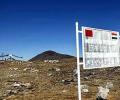
The move was aimed at 'reaffirming China's claim over the state'. China claims the state as 'South Tibet'.
Public interest centres on whether the two leaders might make headway in resolving the Sino-Indian boundary dispute.

'Could the Chinese have taken a leaf out of our book?' 'That their unprecedented build-up is their attempt at coercive diplomacy with India?' 'And if so, what is it that they could be expecting as a quid pro quo?' asks Shekhar Gupta.
No Indian government has taken on China like this ever before and shows that the three top Indian officials -- Sushma Swaraj, Manohar Parrikar and Ajit Doval - ran into China's Great Wall on the twin questions of Pakistan and terror when they interacted with their Chinese interlocutors In past few days, says Rajeev Sharma.

'Given the way in which the PLA operates today, I don't believe local commanders were necessarily acting without approval of higher levels.' 'They were acting in a way which they believed they were carrying out the intent of the higher levels.'

Prime Minister Modi made a strategic blunder of Nehruvian proportions -- presuming no war can happen now, and the Chinese won't be a military threat and risk their economic interests, observes Shekhar Gupta.
Gilgit Baltistan's large frontage with Kashmir and Ladakh across Kargil and the Siachen Glacier gives Pakistan and China the perceived scope for conduct of collusive operations against India and wrest control of the major course of the Indus and Shyok, observes Lieutenant General Syed Ata Hasnain (retd).
In a time of crisis like this, a government needs its people and politics united. A nation of India's size and diversity can't fight a stronger rival with fraying social cohesion, observes Shekhar Gupta.

Nevertheless, border dispute will feature prominently on Modi's agenda but the matter won't be discussed at length. Nayanima Basu reports
'The need of the hour is to build on the positives and control the negatives,' says Colonel (Dr) Anil A Athale (retd).

'Like Nehru, too, Modi has found dealing with Beijing more and more difficult and has adopted an increasingly assertive approach towards managing India's northern neighbour.'
'Ladakh is a tiny salami-slice issue.' 'The big one for China is Arunachal Pradesh, more than 83,000 sq km.' 'Do they imagine they can grab any of this by force?' 'In the 21st century, nursing those thoughts only means you need to get your heads examined.' 'It isn't going to happen,' declares Shekhar Gupta.
'There is a compulsion to look hard, decisive, and risk-taking; start something; and then conclude it in a way you can claim victory.' 'That is not such an easy option against China,' notes Shekhar Gupta.

'This is potentially escalatory, as China does not believe that India has any basis for interfering in a bilateral dispute between China and one of its neighbours.'

Outlining eight "pillars" for the future of India-China relations, President Pranab Mukherjee on Wednesday underlined the need for comprehensively resolving challenges including the boundary question through "political acumen" and "civilisational wisdom".
Today, the Ladakhis and Tibetans have been joined by the Sikhs, the Madrassis, the Garhwalis, the Rajputs, who are well trained psychologically and otherwise, to defend the nation, observes Claude Arpi.
'The Indian government wakes up after the fact when it can do nothing, or rather lacks the will to prosecute military actions to reverse these adverse PLA-driven developments.'

The seventh Tibet Work Forum was held in Beijing on August 28 and 29. Delhi should be deeply concerned, at a time India faces a precarious situation in Ladakh, because the TWF also defines China's western border policies, observes Claude Arpi.

Just like China wants Trump to lose the US presidential poll, it may want Modi to lose the Lok Sabha polls. So months before the 2024 elections, China may take possession of an important area, say one of the Char Dhams, warns Sanjeev Nayyar.

'China's excessive military aid to Pakistan is the real elephant in the room as far as Sino-Indian relations are concerned. India should be confident enough to accept a degree of closeness between China and Pakistan, since China may wish to use this link for its foray into the Muslim world.' 'But the Chinese must be realistic enough to know that as time passes, the tactic of using Pakistan as a proxy to check India will yield diminishing returns. The US tried it for 60 years but failed, so will China,' says Colonel Anil A Athale (retd).

'Clearly, there is a wide gap between the stated intentions of China's top leadership to improve relations with India and the PLA's aggressive border management,' says Brigadier Gurmeet Kanwal (retd).

'Does the Indian army's new assertiveness risk a clash escalating into shooting and possibly skirmishes?' asks Ajai Shukla.

Modi, who is undertaking his first visit to China as prime minister, will reach the ancient city of Xi'an, the home town of President Xi Jinping, for a summit meeting, an unusual departure from normal protocol and seen as a reciprocal gesture by the Chinese leader who was hosted by Modi in Ahmedabad when he visited India in September last year.
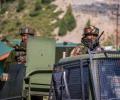
'Why has the peace been kept?' 'Basically because there is a balance.' 'Maybe they think that balance has changed.' 'People can make mistakes. People can miscalculate.' 'If that is the cause, then I think what we have done, matching their build-up, etc, it is giving a good account of ourselves in the face-offs.'

Arpi deserves to be complimented for the commitment and hard work that have gone into this production. The frustrations of seeking reliable documentation from the catacombs of the Indian bureaucracy did not deter him from going after the best information available, and the result is one that he can take much satisfaction in. Ambassador Prabhat P Shukla, Member Advisory Council, Vivekananda International Foundation, reviews Claude Arpi's The End of an Era: India Exits Tibet.

'Ensuring through diplomatic means and in conjunction with strategic partners that India will not be required to fight a simultaneous two-front war with China and Pakistan.' Brigadier Gurmeet Kanwal (retd) lists what India must have in its national security strategy.
 © 2026 Rediff.com - Investor Information - Advertise with us - Disclaimer - Privacy Policy - Sitemap - Feedback - About us - Terms of use - Grievances